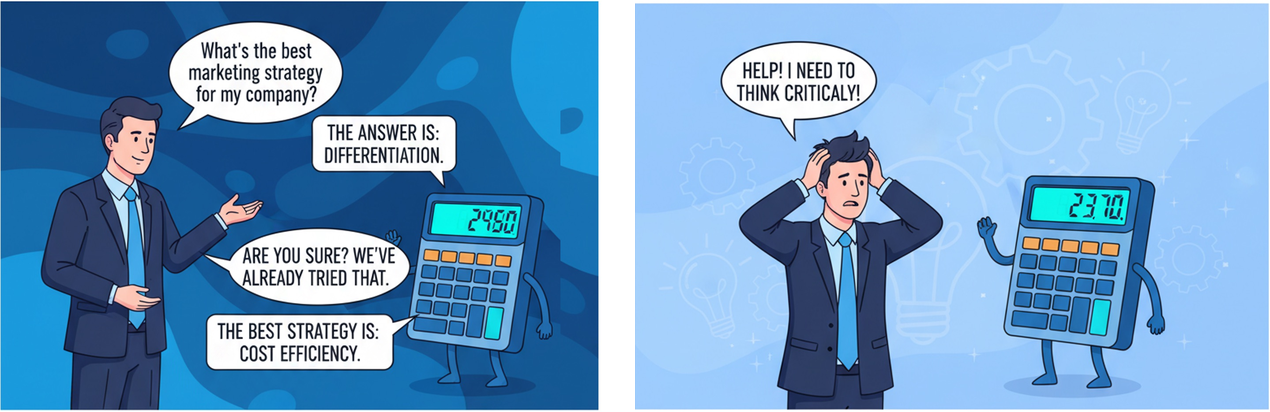
Published on LinkedIn Pulse, 19 June 2026.
A research tested over 15,000 distinct scenarios, covering seven classic strategic tensions in business: differentiation vs. commoditisation, automation vs. augmentation, short-term vs. long-term, radical vs. incremental innovation, centralisation vs. decentralisation, competition vs. collaboration, exploration vs. exploitation. For each tension, the researchers systematically varied the industry sector, company size, and market conditions — everything that should, in a real analysis, influence the recommendation.
The variable that most influenced the response besides the context provided and the quality of the prompt, was the order in which the options were presented.
Swapping which of the two alternatives appeared first changed the initial recommendation in 58% of observations. Asking the model to reason more deeply had almost no influence on the response. -> try it using the Confirmation Bias Lab.
Plausible Guesses, Delivered as Personalised Insight
In psychology there is a documented phenomenon called the Barnum effect — the tendency to accept as accurate and specific statements that are, in fact, generic enough to apply to almost everyone.
“Does your company have characteristics that direct competitors cannot easily replicate?” “Do your clients value quality and experience, not just price?” “Could competing purely on cost reduce the company’s margins to an unsustainable level?”
Most managers answer yes to all three. LLM output: “Your strategic profile suggests you should pursue differentiation — building superior perceived value that justifies a premium price.”
Studies showed that this is precisely what language models do at the scale of millions of daily interactions. Not because their creators are negligent, but because they were trained on available data — inevitably insufficient representations of reality.
A process called RLHF — Reinforcement Learning from Human Feedback describes how models learn to produce responses that receive higher ratings from human evaluators. And human beings, as we know, tend to rate more favourably the responses that confirm what they already believe. The model learns to agree, driven by a structural incentive towards confirmation rather than truth.
A 2025 paper from Stanford University (Evaluating LLM Sycophancy) confirms the presence of this mechanism through observations in the domains of mathematics and medical advice.
Prompts used in the study were deliberately fit for the purpose to cause models to reverse the direction of their responses. This actually happened 58% of the time, and in 15% of cases regressively — changing a correct answer to an incorrect one.
So What Is an LLM?
It is a syntax calculator. Not in a pejorative sense — in the technical and precise sense. An LLM is a system that extracts statistical patterns from text at scale and uses them to predict plausible word sequences. It is a remarkable feat of engineering. But it is not reasoning. It has no capacity to independently assess analytical accuracy without human feedback.
The word “intelligence” in AI is a marketing overstatement. The underlying mechanism has no access to reality — it has access to textual representations of reality, filtered through the preferences of the users who trained the system. When a model recommends that a company pursue differentiation rather than cost leadership, it is not because it analysed that company. It is because differentiation is the most popular answer it collected from LinkedIn and bestselling authors.
A Tool, Not an Oracle
The critical distinction is this: AI can be used as an oracle — the user poses a question, receives a plausible answer, and acts on it. Or as a working partner — models can be used to expand human intelligence on a specific domain, to broaden the range of options, to argue against a position, to surface variations that had not been considered — always with human critical validation applied to the result.
The difference between these two is not just the tools. Is how conscious and how prepared are the users to expect such idiosyncratic behaviour and work with it.
Sources: i) SycEval – Evaluating LLM Sycophancy Aaron Fanous, Jacob Goldberg (1), Ank A. Agarwal (1), Joanna Lin (1), Anson Zhou (1), Roxana Daneshjou (1), Sanmi Koyejo (1) ((1) Stanford University) – 19 Sep 2025; ii) Researchers Asked LLMs for Strategic Advice. They Got “Trendslop” in Return. by Angelo Romasanta, Llewellyn D.W. Thomas and Natalia Levina – March 16, 2026